Showing posts with label Walking. Show all posts

Sunday, May 8, 2011

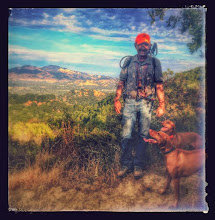
Happy Vizslas Along a Babbling Brook

Happy Vizslas enjoying a cool creek run on an early Sunday morning.  The dogs had a great time.  I had a peaceful and relaxing walk along this delightful, slow-running brook.


A daily walk with my two Vizslas is an essential part of my well-being.

  We explore new places around the eastern valleys and hills of the San Francisco Bay Area. 

Thomas Mann's book: "Herr and Hund" was a great read.  Mann and his German short-haired pointer walked every day in the 1910's in a quiet Bavarian valley.

 Below is a quick summary of the book with its English title: "Bashan and I."
Bashan and I (Pine Street Books)

Bashan and I is the moving story of Thomas Mann's relationship with his spirited German short-haired pointer. From their first encounter at a local farm, Mann reveals how he slowly grows to love this energetic, loyal, and intelligent animal. Taking daily walks in the nearby parkland, Mann begins to understand and appreciate Bashan as a living being, witnessing his native delight in chasing rabbits, deer, and squirrels along with his careful investigations of stones, fallen branches, and clumps of wet leaves. As their bond deepens, Mann is led to contemplate Bashan's inner life, and marvels at the ease with which his dog trusts him, completely putting his life into his master's hands.


Over time, the two develop a deep mutual understanding, but for Mann, there is always a sense of loss at never being able to enter the private world of his dear friend, and he slowly becomes conscious of the eternal divide between mankind and the rest of nature. Nonetheless, the unique relationship quietly moves to the forefront of Mann's life, and when master and companion are briefly separated, Mann is taken aback by the depth of his loneliness without his dog. It is this deep affection for another living creature that helps the writer to reach a new found understanding of the nature of love, in all its complexity.

First published in 1916 and translated into English in 1923, Bashan and I was heralded for its simple telling of how a dog became a priceless companion, an animal who brought meaning to the author's life.

Thomas Mann (1875-1955), author of many novels and stories, including Magic Mountain, Death in Venice, Buddenbrooks, and Doctor Faustus, received the Nobel Prize for Literature in 1929. An ardent antifascist, he left Germany in 1933 and became a U.S. citizen in 1944.

Wednesday, March 16, 2011

Forget the Treadmill - Get a Vizsla

Kevin Moloney for The New York Times

 UNLEASHED

Among dog owners who went for regular walks, 60 percent met federal criteria for regular moderate or vigorous exercise, a new study says.

If you’re looking for the latest in home exercise equipment, you may want to consider something with four legs and a wagging tail.

Several studies now show that dogs can be powerful motivators to get people moving. Not only are dog owners more likely to take regular walks, but new research shows that dog walkers are more active over all than people who don’t have dogs.

One study even found that older people are more likely to take regular walks if the walking companion is canine rather than human.

“You need to walk, and so does your dog,” said Rebecca A. Johnson, director of the human-animal interaction research center at the University of Missouri College of Veterinary Medicine. “It’s good for both ends of the leash.”

Just last week, researchers from Michigan State University reported that among dog owners who took their pets for regular walks, 60 percent met federal criteria for regular moderate or vigorous exercise. Nearly half of dog walkers exercised an average of 30 minutes a day at least five days a week. By comparison, only about a third of those without dogs got that much regular exercise.


The researchers tracked the exercise habits of 5,900 people in Michigan, including 2,170 who owned dogs. They found that about two-thirds of dog owners took their pets for regular walks, defined as lasting at least 10 minutes.

Unlike other studies of dog ownership and walking, this one also tracked other forms of exercise, seeking to answer what the lead author, Mathew Reeves, called an obvious question: whether dog walking “adds significantly to the amount of exercise you do, or is it simply that it replaces exercise you would have done otherwise?”

The answers were encouraging, said Dr. Reeves, an associate professor of epidemiology at Michigan State. The dog walkers had higher overall levels of both moderate and vigorous physical activity than the other subjects, and they were more likely to take part in other leisure-time physical activities like sports and gardening. On average, they exercised about 30 minutes a week more than people who didn’t have dogs.

Do you dance with your cat? Play Frisbee with your dog? Sing with your bird? Send us your videos showing how your pets keep you healthy.

Dr. Reeves, who owns two Labrador mixes named Cadbury and Bella, said he was not surprised.

“There is exercise that gets done in this household that wouldn’t get done otherwise,” he said. “Our dogs demand that you take them out at 10 o’clock at night, when it’s the last thing you feel like doing. They’re not going to leave you alone until they get their walk in.”

But owning a dog didn’t guarantee physical activity. Some owners in the study did not walk their dogs, and they posted far less overall exercise than dog walkers or people who didn’t have a dog.

Dog walking was highest among the young and educated, with 18-to-24-year-old owners twice as likely to walk the dog as those over 65, and college graduates more than twice as likely as those with less education. Younger dogs were more likely to be walked than older dogs; and larger dogs (45 pounds or more) were taken for longer walks than smaller dogs.


The researchers asked owners who didn’t walk their pets to explain why. About 40 percent said their dogs ran free in a yard, so they didn’t need walks; 11 percent hired dog walkers.

Nine percent said they didn’t have time to walk their dogs, while another 9 percent said their dogs were too ill behaved to take on a walk. Age of the dog or dog owner also had an effect: 9 percent said the dog was too old to go for walks, while 8 percent said the owner was too old.


“There is still a lot more dog walking that could be done among dog owners,” Dr. Reeves said.

And the question remains whether owning a dog encourages regular activity or whether active, healthy people are simply more likely to acquire dogs as walking companions.

A 2008 study in Western Australia addressed the question when it followed 773 adults who didn’t have dogs. After a year, 92 people, or 12 percent of the group, had acquired a dog. Getting a dog increased average walking by about 30 minutes a week, compared with those who didn’t own dogs.

But on closer analysis, the new dog owners had been laggards before getting a dog, walking about 24 percent less than other people without dogs.

The researchers found that one of the motivations for getting a dog was a desire to get more exercise. Before getting a dog, the new dog owners had clocked about 89 minutes of weekly walking, but dog ownership boosted that number to 130 minutes a week.

A study of 41,500 California residents also looked at walking among dog and cat owners as well as those who didn’t have pets. Dog owners were about 60 percent more likely to walk for leisure than people who owned a cat or no pet at all. That translated to an extra 19 minutes a week of walking compared with people without dogs.

A study last year from the University of Missouri showed that for getting exercise, dogs are better walking companions than humans. In a 12-week study of 54 older adults at an assisted-living home, some people selected a friend or spouse as a walking companion, while others took a bus daily to a local animal shelter, where they were assigned a dog to walk.

To the surprise of the researchers, the dog walkers showed a much greater improvement in fitness. Walking speed among the dog walkers increased by 28 percent, compared with just 4 percent among the human walkers.

Dr. Johnson, the study’s lead author, said that human walkers often complained about the heat and talked each other out of exercise, but that people who were paired with dogs didn’t make those excuses.

“They help themselves by helping the dog,” said Dr. Johnson, co-author of the new book “Walk a Hound, Lose a Pound,” to be published in May by Purdue University Press. “If we’re committed to a dog, it enables us to commit to physical activity ourselves.”

By TARA PARKER-POPE


--------------------------------------------------------------------------------

Wednesday, March 3, 2010

Walking song with Vizslas

Vizslas, like most dogs, have excellent hearing. They can hear sounds from miles away.

A Vizsla can hear voices and sounds from a much greater distance than humans can.

I walk with Bailey during our field trial training in the open spaces, singing or humming "The Happy Wanderer." Here is a version I found on You Tube.


And here are the words translated from the 1810 German folksong:

The Happy Wanderer
I love to go a-wandering,
Along the mountain track,
And as I go, I love to sing,
My knapsack on my back.

Chorus:
Val-deri,Val-dera,
Val-deri,
Val-dera-ha-ha-ha-ha-ha
Val-deri,Val-dera.
My knapsack on my back.

I love to wander by the stream
That dances in the sun,
So joyously it calls to me,
"Come! Join my happy song!"

Chorus:
"Come! Join my happy song!"

I wave my hat to all I meet,
And they wave back to me,
And blackbirds call so loud and sweet
From ev'ry green wood tree.

Chorus:
From ev'ry green wood tree.

High overhead, the skylarks wing,
They never rest at home
But just like me, they love to sing,
As o'er the world we roam.

Chorus:
As o'er the world we roam.

Oh, may I go a-wandering
Until the day I die!
Oh, may I always laugh and sing,
Beneath God's clear blue sky!

Chorus:
Beneath God's clear blue sky!


I have been humming or singing the words to this song for over a year now. Bailey knows where I am from the sounds and doesn't have to keep coming back to "check in."


Bailey can be out 1/4 mile away, and since he hears me, he knows where I am.


Since he knows where I am, he is comfortable staying "out there" and hunting.


Judges during a field trial do not want a dog to keep coming back to the handler. This is one of the harder parts in training a pup to run in a competitive derby stake.
A rookie handler might want their dog close by so that he/she doesn't get lost. I make it Bailey's responsibility not to get lost, not mine.


Field trial judges, I have come to find out over my rookie season, are looking for those hunting dogs that can independently hunt and work the field out in front of the handler.

So, if you ever hear me singing "The Happy Wanderer" on a walk or at a field trial, don't be overly concerned.

I haven't totally lost it. Not totally.

It's all a part of the communication skills Bailey and I are developing.

Sunday, July 12, 2009

Point Pinole Vizsla Walk

The fields are free of foxtails! Yeah. Bailey and Chole joined a Vizsla Walk group for a two hour walk through the fields and paths of Point Pinole Regional Park. Foxtails have been replaced with fennel and lilac bushes. The tide was out so the mud was nice and mushy and cool. The dogs had a blast!


Could you find a better looking group? Sunday morning (this morning) and this group had been walking in the Point Pinole Park for about an hour. Around the drinking fountain by the pier the dogs had to "leash up" for the first time since the parking lot. Took the opportunity to get a jogger to grab a group picture.


As usual, for the first 15 minutes of the walk, the dogs are exploding with the pent up energy they have stored up over night. A group of Vizslas could run a small city with their pent up energy.


Here is a dog pack at its finest. They know that their humans came with them on this walk but they are with their kind.

Nothing could be better for a city or suburban Vizsla than to get to run and play like this!


Sunday, July 5, 2009

Fourth of July long walk

Well , the 4th of July parade started at 9 am in Danville, California, so in leaving my house on foot with the two dogs at 7 am, I felt I had left enough time to make it. I knew it was going to be a good, long walk.

Three hours later, with only a quick stop downtown to grab a coffee, we finally were watching the parade go by (what was left of it). Miscalculated how far it was (a little over nine miles). Met Joanie at the 5-mile-to-go mark (she drove to this point).

Chloe hated the noise of the drums and shook and pulled. She was not having a good time. Bailey enjoyed everything about it. Took some pictures to post and SD card in my camera went bad and I lost all those pictures. Oh well.

So, after 15 minutes it was back on the Iron Horse trail for the three-hour walk back home. Left at 7:00 and got home at 2:30. The dogs and I took a nice two-hour nap.

Great way to spend the 4th.

Tuesday, June 30, 2009

The Importance of Mastering the Art of the Walk


The below section is from Cesar Millan. This gave me a idea of how walking Chloe and Bailey on leash for long distances helps them.

In his first book he talked about how a homeless person's dog is so well behaved.

So at least three times a week we walk on leash for one or two hours. At least once a week we walk downtown Walnut Creek so they are comfortable with traffic and people.

I figure Chloe and I have logged 600 miles in the last 22 months of leash-time walking. Bailey has about half that. They both must stay on my left and just behind or to my side. Bailey, being the young gentledog he is, stays to the outside to protect his older sister.


"The single most powerful tool we have for bonding with our dogs is the walk. Walking is a primal exercise that awakens all of her pack instincts. No amount of toys or treats will make her happier than a brisk, hourly walk by your side. Yet the walk is one area where dog owners seem to have the most problems. Most people have the dog out in front, pulling them forward. I’ve asked the reason for this and I usually get, “She loves her freedom.” Freedom?

A dog is a pack animal and what she really wants from the walk is leadership and structure. To me, the best role models for great dog walking technique are the homeless and the service dog-using handicapped! Why? They seem to better understand the concept of canine pack leadership. The leader is always in front during the walk. And for many homeless, their dogs often aren’t even on a leash – they choose to stay behind or beside their owners.

Of course a dog wants to sniff the ground and pee on a tree during the walk, but it is important that we as pack leaders understand that we should be making the “when and where” decisions for them. Following our rules gives the dog confidence because she’s working for every privilege she gets." - Cesar Millan