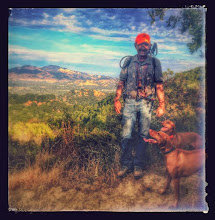
Bailey is 60 pounds. A male of all muscle and built like a tank. Some people mistake him for a small Rhodesian Ridgeback.
Chloe is 43 pounds. She is a very fit and trim female and is equipped with a loud bark.
Now that the dogs are adults and no longer puppies, I have noticed a change. Chloe is going on 4 and Bailey is almost 3. They are both much more confident. They have learned to mind me and obey my commands.
Important qualities in a watch / guard dog.
The many long hikes on hill trails and busy city street walks, along with much of the field trial training we've done, have crossed over quite well.
At home, when someone drives up the drive, Chloe barks a high-noted notice. "Someone is here." Bailey doesn't bark much. When he does, it is low and loud.
He stands guard at the gate or door.
They both look intimidating at the gate.
If I was a thief or robber, I would find another house to choose.
Chloe is our watch dog and Bailey is our guard dog.
We both feel safer with our Vizslas "on guard."
Stories from friends about their "guard dogs:"
"Years ago when I only had one Vizsla, one night my bedroom sliding outside door screen was temporally off being fixed. Being summer the sliding door was wide open. About 3AM there was a loud clatter and I woke to see a guy climbing over the 6Ft high back fence, 10 feet from my open sliding door. I was scared, this just doesn't happen in down town Palo Alto. Both my dog and I froze for a few moments, then my Vizsla jumped off the bed and went flying out the open door barking like a over sized pit bull. The guy heard the dog and took a few quick steps and clamored over the next 6 Ft fence into the neighbors yard. This was a normal female V, not a trained guard dog. That dog was impressive, a really fierce bark and after the guy.
Soon there was lots of noise coming from the street. I got dressed and went out to the front yard (yes, taking the dog with me). The street was swarming with cops. A guy had broken into a woman's house, robbed her and then was jumping fences and running through the back yards trying to escape. They caught him further down the street.
Before this I wondered what a V would do if they detected real fear in an owner, now I know; very impressive. I hope to never have to test that dog reaction again but have much more respect for the Vizsla security system if needed."
Dirf
And then:
Years ago when I lived in Oakland, we had an alarm on the house. One day it went off and the Oakland police called me at work about it so I went flying home. When I got there, the police told me they did not see any evidence of a break in but they would stay until I checked the house out to be sure. The entire time the two vizslas (yes, there was a time I had only two) were barking their heads off.
As the police were leaving one said to me:
"
Lady, you're wasting your money on that alarm system.
No one would break into a house with dogs barking like that."
I called the alarm company the next day and told them to discontinue the service. So yes, I do feel safe with my v's."
Kay
And finally this fantastic story from a Vizsla Talk post:
Stories of Vizslas as guard dogs
"Many years ago, I was working as a campus minister in an inner-city setting, and I often was there alone late into the evening. I had a Doberman puppy that I wanted to have accompany me to work, so I sought advice on how best to train her. I needed her to be welcoming and non-threatening to the many people who came to the ministry, but provide at least a "visual deterrence" to anyone who wished me ill.
I found a trainer in New York City who specialized in training dogs who would accompany their owners to their workplaces. He told me to teach my puppy basic obedience - preferably at a dog training club or other group setting, where she would be well socialized and learn to obey despite distractions. In addition, he said, I should take the puppy with me wherever I could, much as one would do when training an assistance dog.
Under no circumstances, he said, was I to intentionally train the dog to "guard" or to have any sort of attack command. A dog who loves you, he said, will always know the difference between a friendly visitor and someone who means you harm and be willing to take care of you, but a dog who has an attack command is susceptible to misinterpreting your signals, and that can lead to a bad outcome.
How right he was. This was a very busy ministry, and in addition to college students, we ministered to a large number of homeless folks. My wonderful Dobe was a great companion (and therapist) to them all. After a couple of years, we moved on to a boarding school, where I was the chaplain and directed a dormitory of 70 teenage boys. Our Dobe was in heaven, having 70 boys always ready to pet her or play with her.
In all her (15+) years with me, my Dobe girl got tough only twice. Once was when a man tried to break into our house while I was home alone. He managed to kick in the door, knocking it off its hinges, but he did not make it into the house. The second time my Dobe guarded me, it required more finesse on her part. A student in the boarding school came walking down the dorm hallway one afternoon, walking toward my open study door. This was a common occurrence in our dorm, where I always kept the door to my study open if I
was home. My Dobe would lie obediently in the doorway, eagerly waiting for my signal to greet whatever boy was coming our way.
This time, though, as the boy approached the door, my girl came slowly up into a low crouch, a menacing growl in her throat. Hearing this, I looked up to see the boy walking toward us. I had no idea what was going on, but I trusted my dog. So I told the boy, "You better not come any closer. She means it, and I have no intention of calling her off." He muttered something, then turned and quietly walked away. Just about the time he was out of sight, my phone rang. It was the headmaster calling to warn me that he had just kicked this boy out for being caught with drugs, and he had left the headmaster's office threatening to "get me," believing (mistakenly) that
I had turned him in.
We are no longer at the boarding school, but my husband still teaches at a high school, and over the years we have fostered several teenage boys and hosted some teenage foreign exchange students. We had to send one of those foreign exchange students home. This came after we had become Vizsla people, and our Vizsla boy at the time was the jolliest, friendliest dog we had ever had.
When this new student arrived, our Vizsla welcomed him immediately. Two or three days later, the student went on a bus trip to D.C. with some teachers and other foreign exchange students. The afternoon the student returned to our home, our Vizsla went running to the door to greet him. Then, all of a sudden, the Vizsla whimpered and turned tail and ran up the stairs to our bedroom. I was watching this scene, and I saw no indication that the student had touched the Vizsla or said anything unpleasant to him. But, once again, I knew to trust my dog. I phoned the headmaster only to learn that he was about to phone me. A female teacher who had been a chaperone on the bus trip had just reported to him that this student had assaulted her on the bus at a time when they were the only two present. The school was
sending someone to our home to retrieve the student and take him to the airport.
That New York trainer who advised me on training my Dobe told me he believed that dogs can smell the pheromones and other odors we humans give off with our emotions. In addition, of course, dogs are much better than we are at reading body language. Combined, he said, these two abilities give a well-adjusted dog a nearly perfect ability to know the difference between a threatening person and a benign one. That trainer was saying this over 30 years ago, but all of the science since then has only gone to support his theory. I rest easy knowing that my otherwise friendly and welcoming Vizslas will protect me, when - and only when - they need to."
Grace and Peace,
Leslie