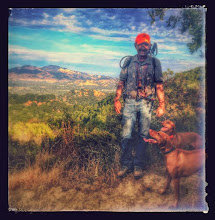
Had a discussion with Bailey's breeder, Kay Ingle yesterday about "Alpha males" and dominate behavior during a Vizsla Walk. I called Bailey a "Alpha male." She told me that Bailey most-likely wasn't an Alpha male. Alpha male dogs are very rare in human society. The simple reason is that humans for many thousands of years have taken over that role.
We are "dog sitting" another male Vizsla for a week and Bailey and Moose had to sort out some "middle-ranking pack" issues.
As of tonight, the two males have worked it out and are getting along very well.
Kay was good enough to send me the below article. Interesting stuff.
The History and Misconceptions of Dominance Theory
Note: The information in the following article came from an interview with Dr. Ian Dunbar, who spent nine years studying the social behavior of dogs during the study mentioned below. In an earlier version of this article, Dr. L. David Mech was credited with the 30-year study. This was a mistake. The researcher who conducted the study was Dr. Frank Beach. An effort has been made to correct this error. However, if you know of a place where the original article was published, please notify the editor and request a correction.
The original alpha/dominance model was born out of short-term studies of wolf packs done in the 1940s. These were the first studies of their kind. These studies were a good start, but later research has essentially disproved most of the findings. There were three major flaws in these studies:
These were short-term studies, so the researchers concentrated on the most obvious, overt parts of wolf life, such as hunting. The studies are therefore unrepresentative -- drawing conclusions about "wolf behavior" based on about 1% of wolf life.
The studies observed what are now known to be ritualistic displays and misinterpreted them. Unfortunately, this is where the bulk of the "dominance model" comes from, and though the information has been soundly disproved, it still thrives in the dog training mythos.
For example, alpha rolls. The early researchers saw this behavior and concluded that the higher-ranking wolf was forcibly rolling the subordinate to exert his dominance. Well, not exactly. This is actually an "appeasement ritual" instigated by the SUBORDINATE wolf. The subordinate offers his muzzle, and when the higher-ranking wolf "pins" it, the lower-ranking wolf voluntarily rolls and presents his belly. There is NO force. It is all entirely voluntary.
A wolf would flip another wolf against his will ONLY if he were planning to kill it. Can you imagine what a forced alpha roll does to the psyche of our dogs?
.
Finally, after the studies, the researchers made cavalier extrapolations from wolf-dog, dog-dog, and dog-human based on their "findings." Unfortunately, this nonsense still abounds.
So what's the truth? The truth is dogs aren't wolves. Honestly, when you take into account the number of generations past, saying "I want to learn how to interact with my dog so I'll learn from the wolves" makes about as much sense as saying, "I want to improve my parenting -- let's see how the chimps do it!"
Dr. Frank Beach performed a 30-year study on dogs at Yale and UC Berkeley. Nineteen years of the study was devoted to social behavior of a dog pack. (Not a wolf pack. A DOG pack.) Some of his findings:
1. Male dogs have a rigid hierarchy.
2. Female dogs have a hierarchy, but it's more variable.
3. When you mix the sexes, the rules get mixed up. Males try to follow their constitution, but the females have "amendments."
4. Young puppies have what's called "puppy license." Basically, that license to do most anything. Bitches are more tolerant of puppy license than males are.
5. The puppy license is revoked at approximately four months of age. At that time, the older middle-ranked dogs literally give the puppy hell -- psychologically torturing it until it offers all of the appropriate appeasement behaviors and takes its place at the bottom of the social hierarchy. The top-ranked dogs ignore the whole thing.
There is NO physical domination. Everything is accomplished through psychological harassment. It's all ritualistic.
6. A small minority of "alpha" dogs assumed their position by bullying and force. Those that did were quickly deposed. No one likes a dictator.
7. The vast majority of alpha dogs rule benevolently. They are confident in their position. They do not stoop to squabbling to prove their point. To do so would lower their status because...
8. Middle-ranked animals squabble. They are insecure in their positions and want to advance over other middle-ranked animals.
9. Low-ranked animals do not squabble. They know they would lose. They know their position, and they accept it.
10. "Alpha" does not mean physically dominant. It means "in control of resources." Many, many alpha dogs are too small or too physically frail to physically dominate. But they have earned the right to control the valued resources. An individual dog determines which resources he considers important. Thus an alpha dog may give up a prime sleeping place because he simply couldn't care less.
So what does this mean for the dog-human relationship?
Using physical force of any kind reduces your "rank." Only middle-ranked animals insecure in their place squabble.
To be "alpha," control the resources. I don't mean hokey stuff like not allowing dogs on beds or preceding them through doorways. I mean making resources contingent on behavior. Does the dog want to be fed. Great -- ask him to sit first. Does the dog want to go outside? Sit first. Dog want to greet people? Sit first. Want to play a game? Sit first. Or whatever. If you are proactive enough to control the things your dogs want, *you* are alpha by definition.
Train your dog. This is the dog-human equivalent of the "revoking of puppy license" phase in dog development. Children, women, elderly people, handicapped people -- all are capable of training a dog. Very few people are capable of physical domination.
Reward deferential behavior, rather than pushy behavior. I have two dogs. If one pushes in front of the other, the other gets the attention, the food, whatever the first dog wanted. The first dog to sit gets treated. Pulling on lead goes nowhere. Doors don't open until dogs are seated and I say they may go out. Reward pushy, and you get pushy.
Your job is to be a leader, not a boss, not a dictator. Leadership is a huge responsibility. Your job is to provide for all of your dog's needs... food, water, vet care, social needs, security, etc. If you fail to provide what your dog needs, your dog will try to satisfy those needs on his own.
In a recent article in the Association of Pet Dog Trainers (APDT) newsletter, Dr. Ray Coppinger -- a biology professor at Hampshire College, co-founder of the Livestock Guarding Dog Project, author of several books including Dogs : A Startling New Understanding of Canine Origin, Behavior, and Evolution; and an extremely well-respected member of the dog training community -- says in regards to the dominance model (and alpha rolling)...
"I cannot think of many learning situations where I want my learning dogs responding with fear and lack of motion. I never want my animals to be thinking social hierarchy. Once they do, they will be spending their time trying to figure out how to move up in the hierarchy."
That pretty much sums it up, don't you think?
Melissa Alexander
mca @ clickersolutions.com
copyright 2001 Melissa C. Alexander


 My wife found this book: Bashan and I in the Harvard Bookstore in her trip to Boston last week. I have been reading it and it is a delightful read. The review of the book does better then I can so I just post it here. - Rod